
Japanese New Year Food: Osechi, Ozoni & Kagami Mochi Explained

Honoka Tsuchida
founder of WA Japan Gift
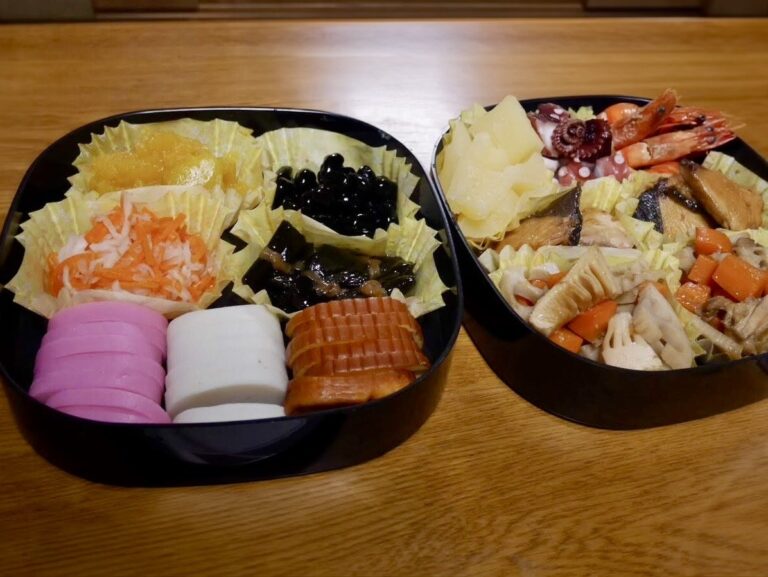
Japanese New Year food is a set of traditional dishes eaten from December 31
to the first days of January. The main ones are osechi ryori (a box of celebratory dishes), ozoni (a soup with mochi), kagami mochi (a rice cake decoration that is later eaten),
and toshikoshi soba (buckwheat noodles eaten on New Year’s Eve).
Almost every dish carries a wish for the year ahead, such as good health, long life or a good harvest.
New Year, or oshogatsu, is the most important holiday of the year in Japan. Families gather, shops close, and the kitchen is full of food that has been prepared for days. In this guide,
I’ll walk you through what we eat, what each dish means, and how my own family celebrates.
What is oshogatsu?
Oshogatsu (お正月) is the Japanese New Year. The biggest days are January 1 to 3,
but the season really starts on New Year’s Eve (omisoka) and continues into mid-January.
During this time, many people:
- Visit a shrine or temple for hatsumode, the first prayer of the year
- Eat osechi and ozoni with family
- Decorate their homes with kagami mochi and kadomatsu (pine and bamboo decorations)
- Send New Year cards called nengajo
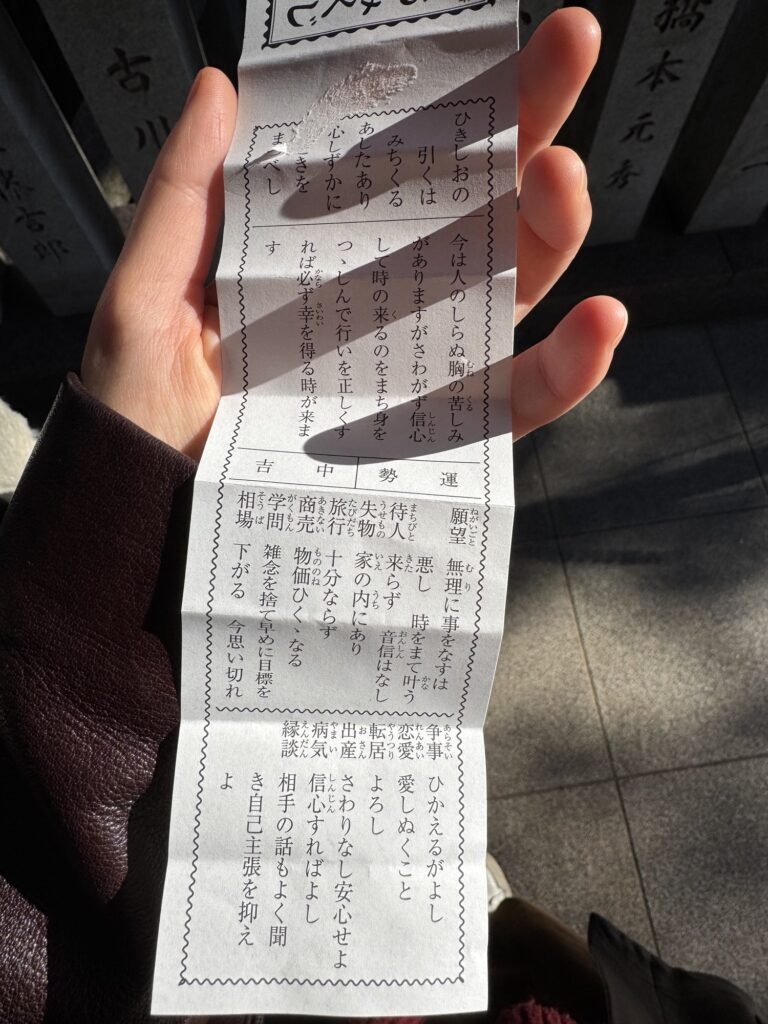
At the shrine, many people also draw an omikuji, a paper fortune that tells you what kind of year to expect. I drew this one on my own New Year shrine visit.
If the fortune is bad, you can tie it to a rack at the shrine and leave the bad luck behind.
Food sits at the center of it all. Most New Year dishes are made in advance,
and there’s an old idea behind that: the first days of the year should be a time to rest,
even for the person who usually cooks.
Toshikoshi soba: the last meal of the year
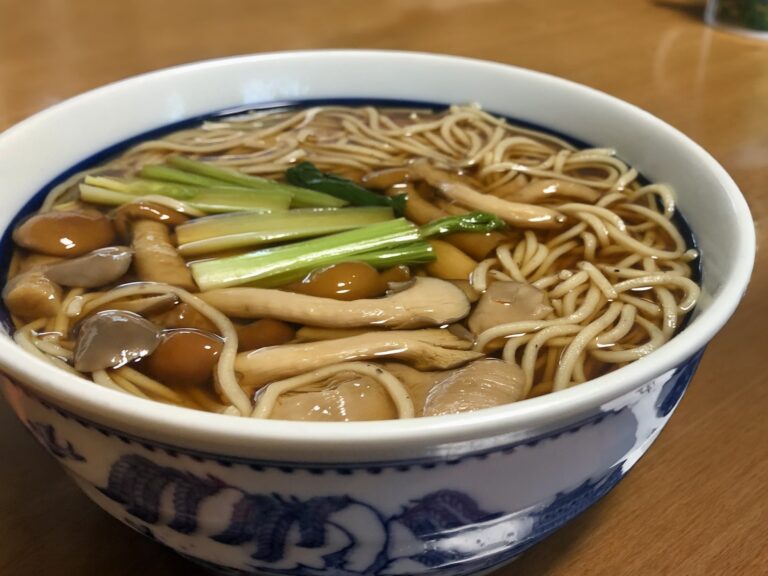
The New Year food season begins on December 31 with toshikoshi soba (年越しそば), which means “year-crossing noodles.”
Soba noodles are long and thin, so they’re eaten as a wish for a long life. They also break easily, which represents cutting away the hardships of the past year. Most families eat them on the evening of New Year’s Eve, before midnight.
My family eats toshikoshi soba every year. Ours is a warm bowl topped with mushrooms and greens, and eating it is the moment when it really feels like the year is ending.
Osechi ryori: the New Year food box
Osechi ryori (おせち料理) is the star of Japanese New Year food. It’s a collection of small dishes packed into stacked lacquered boxes called jubako. The stacking itself has meaning: it’s a wish for happiness to pile up, layer upon layer.
Osechi is usually eaten on the morning of January 1, often over the first three days. Many dishes are sweet, salty or vinegared so that they keep well without cooking.
My family makes osechi at home every year, like the boxes in the photo at the top of this page.
My favorite dish is nishime, also called chikuzen-ni: root vegetables such as lotus root, carrot and taro, slowly simmered in a sweet soy broth. Because many vegetables are cooked together in one pot, it’s said to represent a family that stays close.
What's inside osechi, and what each dish means
| Dish | What it is | The wish behind it |
|---|---|---|
| Kuromame | Sweet simmered black soybeans | To work hard and stay healthy (mame also means "diligent") |
| Kazunoko | Herring roe | Many children and a prosperous family |
| Tazukuri | Small dried sardines glazed with soy and sugar | A good harvest |
| Kohaku kamaboko | Red and white fish cake | Celebration and protection (red and white are lucky colors) |
| Datemaki | A sweet rolled omelet | Learning and culture (it looks like a rolled scroll) |
| Kurikinton | Mashed sweet potato with sweet chestnuts | Wealth (its golden color looks like gold) |
| Ebi | Shrimp | A long life, until your back bends like a shrimp's |
| Kombu maki | Rolled kelp | Joy (kombu sounds like yorokobu, "to be happy") |
| Renkon | Lotus root | A clear view of the future (it has holes you can see through) |
| Nishime | Root vegetables simmered in a sweet soy broth | A family that stays close (many vegetables cooked together in one pot) |
You don’t need to know every dish to enjoy osechi. The idea is simple: each bite is a small wish for the new year.
If you’re trying osechi for the first time, start with kurikinton and datemaki. Both are sweet and easy to like, and kurikinton is very close to a Japanese sweet.
Send a taste of the Japanese New Year
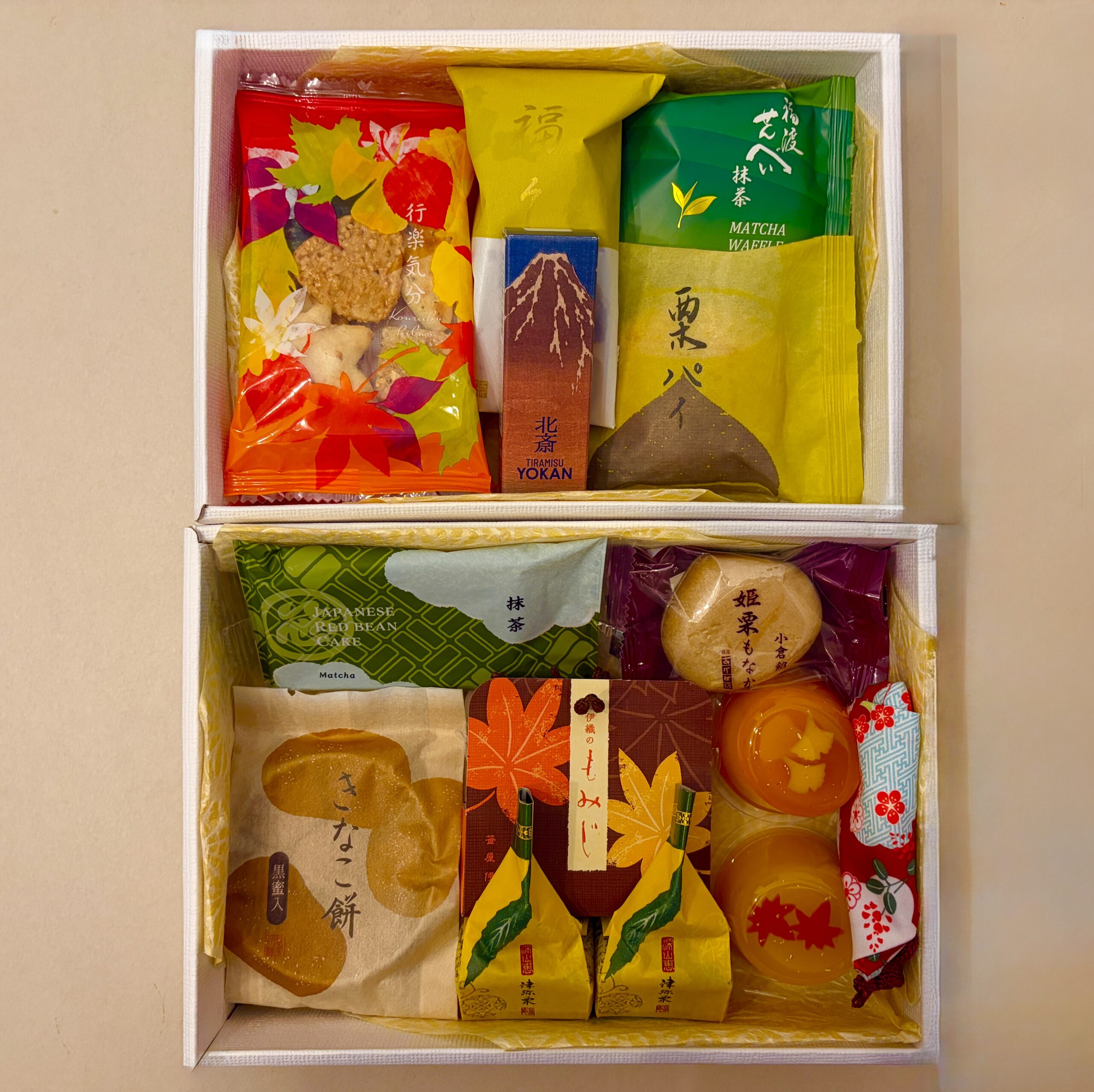
Our Winter box arrives in January, right in the Japanese New Year season. Each box holds 10+ seasonal Japanese sweets, hand-picked from confectioners across Japan and wrapped in washi paper. Order by December 15.
See the seasonal box →Photo: our Autumn 2026 box. Contents change every season.
Ozoni: the New Year soup with mochi
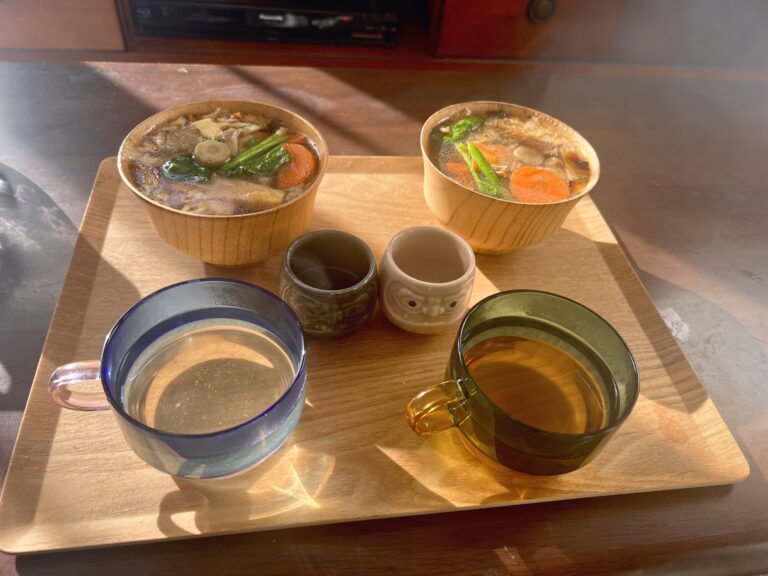
Ozoni (お雑煮) is a soup with mochi rice cakes, eaten on the morning of New Year’s Day. It’s one of the most personal dishes in Japan, because every region, and almost every family, makes it differently.
A few common styles:
- Clear soup (sumashi): a light dashi broth seasoned with soy sauce, common in eastern Japan including Tokyo. It often includes chicken, greens and kamaboko.
- White miso: a sweeter, creamy broth, common in the Kyoto and Osaka area.
- Sweet red bean: in a few regions, ozoni is made with sweet adzuki beans, a bit like a warm dessert soup.
The mochi changes too. Eastern Japan often uses square mochi that are grilled, while western Japan often uses round mochi that are boiled.
My family’s ozoni is a clear soup full of vegetables, with round mochi that we toast until they puff up and turn golden. Round mochi is more common in western Japan and clear soup in the east, so our bowl is a small example of how every family has its own version.
If you’d like to know more about mochi itself, I explain it in my guide, What Is Mochi?
Kagami mochi: a decoration you eat later
Kagami mochi (鏡餅) is a New Year decoration made of two round mochi stacked on top of each other, usually with a small bitter orange called daidai on top. The name means “mirror rice cake,” because its round shape looks like the old bronze mirrors kept at shrines.
The two layers represent the old year and the new year, and daidai sounds like the word for “generation after generation,” a wish for the family to continue.
Kagami mochi is placed in the home at the end of December.
Then, in mid-January, comes kagami biraki (鏡開き), or “opening the mirror.”
In the Tokyo area it’s usually done on January 11. The mochi has become hard by then,
so it’s broken into pieces with a wooden mallet or by hand.
It’s never cut with a knife, because cutting is thought to bring bad luck.
The pieces are then eaten, often in a warm, sweet soup called oshiruko or zenzai.
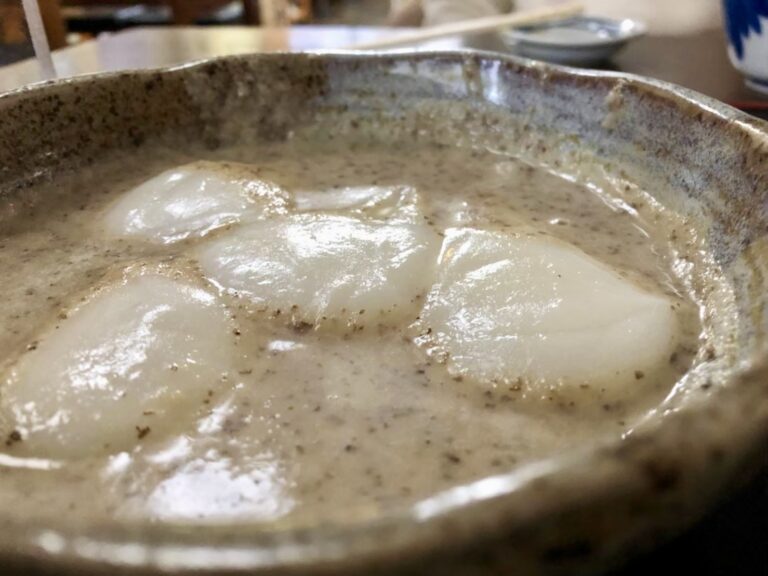
We decorate kagami mochi at home every year. After kagami biraki, we toast the pieces and eat them with soy sauce. The hard mochi turns crispy on the outside and soft and stretchy inside.
Sweets and the Japanese New Year
New Year in Japan is also a season for special sweets. Wagashi shops make sweets in red and white, the colors of celebration, and in the shapes of pine, plum blossoms and cranes, which are all symbols of good luck.
In my neighborhood, the New Year season also ends with dondo-yaki, a fire festival where people burn their New Year decorations and roast mochi or dango over the flames. It’s said that eating them keeps you healthy for the year.
If you want to learn more about these seasonal sweets, read my guide What Is Wagashi?
Tips for eating Japanese New Year food
- Eat mochi carefully. Mochi is very sticky. Every New Year in Japan, there are reminders to cut it into small pieces and chew well, especially for young children and older adults.
- Try a little of everything. Osechi is about variety, not big portions.
- Ask about the meaning. If you’re celebrating with a Japanese family, asking “What does this one mean?” is a great way to start a conversation.
- Use the special chopsticks. At New Year, many families use iwai-bashi, chopsticks that are tapered at both ends: one end for you, and one for the gods.
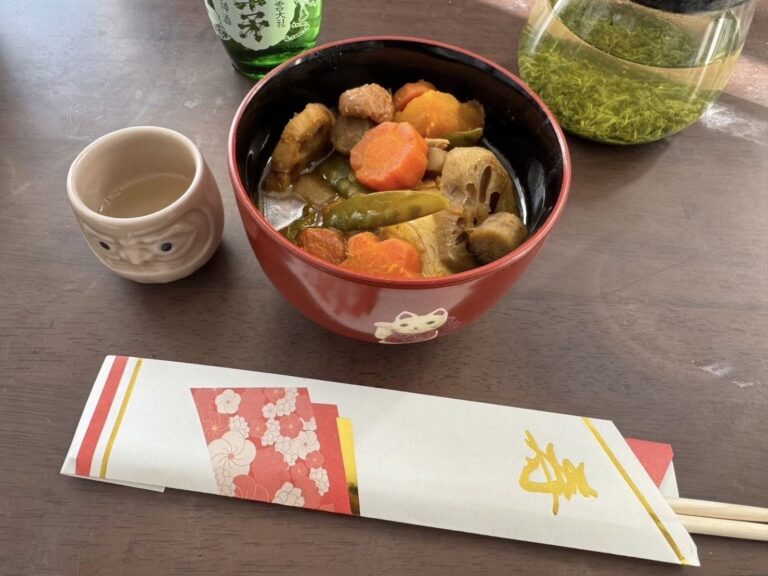
A taste of the Japanese New Year, wherever you are
The Japanese New Year is a season of wishes: for health, for family, for a good year ahead. That feeling is what I hope to share through WA Japan Gift.
Our Winter box is filled with 10+ seasonal Japanese sweets, hand-picked from confectioners across Japan and wrapped in washi paper. It arrives in January, right in the Japanese New Year season.
→ See the seasonal box Order by December 15 to receive the Winter box in January.
FAQ
What is the traditional Japanese New Year food? The main dishes are osechi ryori (a box of celebratory dishes), ozoni (a soup with mochi), kagami mochi (a mochi decoration that’s later eaten), and toshikoshi soba (noodles eaten on New Year’s Eve).
What is osechi? Osechi ryori is a collection of small, colorful dishes packed into stacked lacquered boxes and eaten during the first days of January. Each dish carries a wish for the new year, such as health, wealth or a good harvest.
What is ozoni? Ozoni is a soup with mochi rice cakes eaten on New Year’s morning. The broth and the shape of the mochi differ by region: clear soup with square mochi is common in eastern Japan, and white miso with round mochi in western Japan.
What do you do with kagami mochi? Kagami mochi is displayed at home over the New Year and broken into pieces in mid-January, a custom called kagami biraki. The pieces are often eaten in a sweet red bean soup.
Why do Japanese people eat soba on New Year’s Eve? Long soba noodles represent a long life, and because they break easily, they also symbolize cutting away the hardships of the past year.
About the author: Honoka Tsuchida is the founder of WA Japan Gift. Based in Tokyo, she curates seasonal wagashi from across Japan and shares Japanese food and gift culture with people around the world. Read our story →